Purpose
This briefing highlights the key implications of the CIOMS Working Group XIV report on Artificial Intelligence in Pharmacovigilance (PV) published in December 2025[1] and outlines considerations for organisations deploying AI in safety surveillance.
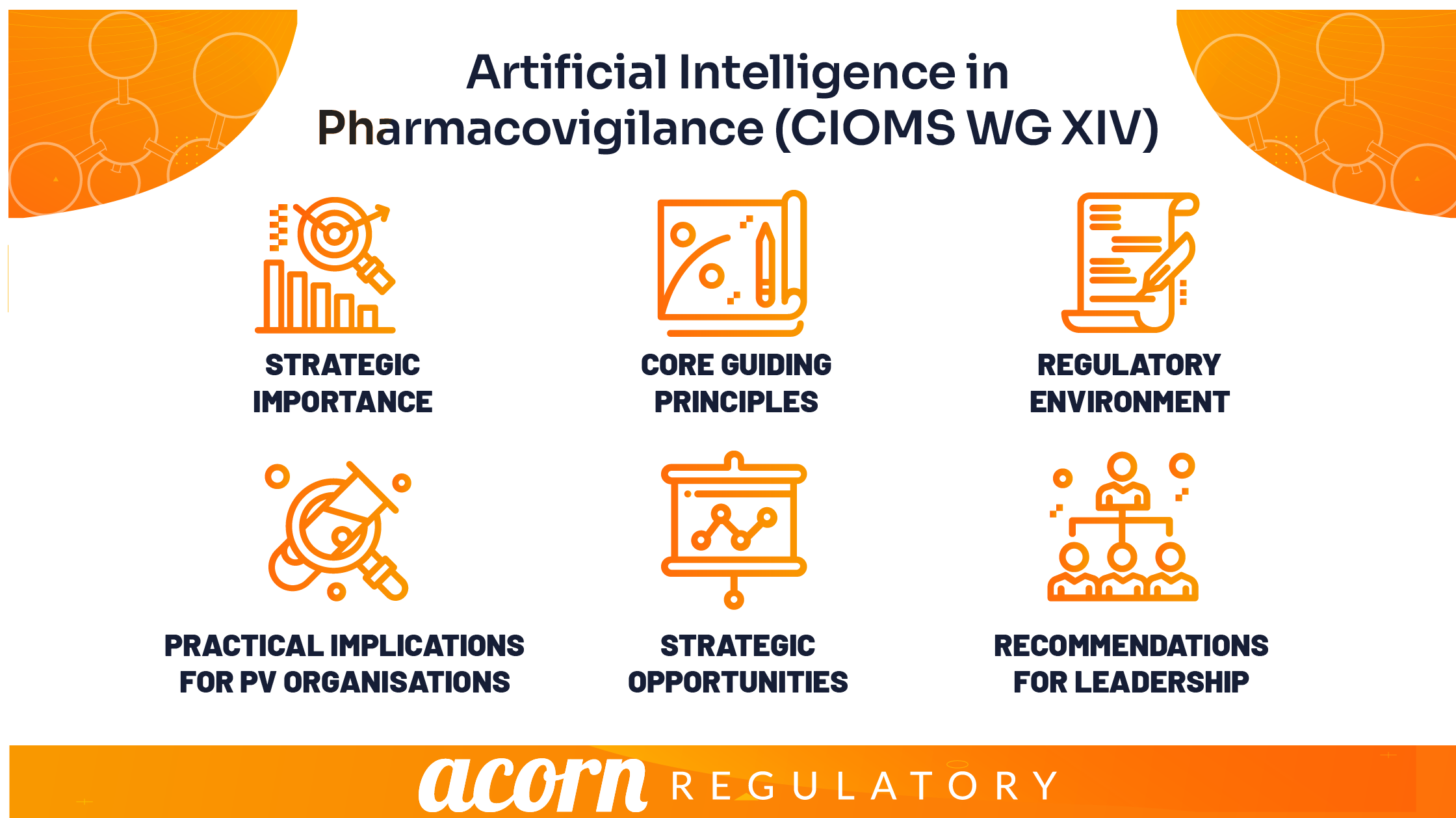
- Strategic Importance
AI is rapidly transforming PV, offering major opportunities to increase efficiency, accuracy, and scalability across ICSR processing, signal detection, and safety analytics.
The challenges of establishing and maintaining progressively more complex PV systems in a globally diverse and evolving regulatory environment are increasing. There is a need to rethink traditional PV strategies based on existing pressures on the one hand (e.g. increasing volumes and increasing regulatory complexity) and increasing data sources on the other. Case volumes are increasing, budgets are not! Applying innovative automation tools and processes to PV is no longer an option but an essential need.
However, AI involves a rapidly emerging cross-disciplinary field that is at the intersection of PV, computer science, mathematics, regulation, law, medicine, human rights, psychology and social science!
Adoption must be safe, ethical, transparent, and governed by robust controls due to risks of error, privacy violations, and bias and of course within your budget.
The CIOMS framework provides a global, consensus-based foundation for responsible AI use.
- Core Guiding Principles
The report centres on seven guiding principles essential for trustworthy AI in PV:
Risk‑Based Approach
- AI oversight, validation depth, and transparency should scale with decision criticality and AI autonomy.
- Continuous risk assessment and documentation are required throughout the AI lifecycle.
Human Oversight
- Human roles remain essential in design, monitoring, and decision-making.
- Oversight modes include human‑in‑the‑loop, human‑on‑the‑loop, and human‑in‑command depending on risk.
- AI adoption will drive role evolution and upskilling in PV teams.
Validity & Robustness
- AI must demonstrate fit‑for‑purpose performance under realistic conditions using appropriate qualitative and quantitative evaluation.
- Test sets should be representative and address challenges such as rare events, data variability, and data drift.
Transparency
- Organisations must clearly disclose where AI is used, model purpose, assumptions, intended inputs/outputs, and limitations.
- Explainability is valuable but may be limited depending on the AI system.
Data Privacy
- GenAI/LLM systems increase re-identification risks; strengthened privacy controls and data-protection‑impact assessments are required.
- PV operations must meet global privacy regulations (e.g., GDPR, HIPAA, LGPD, PIPL).
Fairness & Equity
- AI must avoid perpetuating bias or disadvantaging subpopulations.
- Training and test data require sufficient demographic and geographic representation.
Governance & Accountability
- A comprehensive governance framework must define roles, responsibilities, lifecycle controls, versioning, and auditability.
- Governance must evolve with emerging risks and regulatory expectations.
- Regulatory Environment
Global regulators increasingly require risk‑based AI oversight, robust documentation, and early engagement:
- EU AI Act (2024): classifies high-risk AI and mandates stringent controls.
- EMA AI Reflection Paper (2024): requires rigorous validation and human oversight in PV.
- US FDA: draft guidance emphasises model credibility, risk assessment, and lifecycle monitoring.
- Practical Implications for PV Organisations
- AI is already used in real‑world PV for duplicate detection, ICSR triage, coding, signal detection, literature monitoring, and document summarisation.
- Implementation requires:
- Clear problem definition and context of use
- Multidisciplinary collaboration (PV, data science, QA, legal, IT)
- Continuous monitoring, retraining, and drift management
- Integration into existing QMS
- Staff training and competency development
- Robust vendor qualification processes
- Strategic Opportunities
- Improved throughput and timeliness in ICSR processing
- Enhanced sensitivity/specificity in signal detection
- Better utilisation of unstructured data (LLMs)
- Ability to shift from reactive to predictive safety surveillance
- Differentiation in service quality and operational efficiency
But these benefits hinge on rigorous safety, privacy, governance, and oversight frameworks.
- Recommendations for Leadership
- Adopt the CIOMS guiding principles as the baseline for all AI use.
- Establish an AI governance committee with PV, QA, data science, and legal representation.
- Mandate risk assessments and documentation for each AI system.
- Prioritise staff upskilling (AI literacy, validation, oversight).
- Ensure transparency in AI-supported PV processes for clients and regulators.
- Engage early with regulators where high-impact AI systems are involved.
[1] Artificial Intelligence in Pharmacovigilance – CIOMS (https://doi.org/10.56759/cdob6397)