Across Good x Practice (GxP) environments, a strong Quality Management System (QMS) is a key driver of performance, supporting quality and compliance throughout the product lifecycle and supply chain.
Beyond maintaining regulatory compliance and inspection readiness, an effective QMS helps protect patients by ensuring that quality, safety and product integrity remain at the heart of every process and decision.
But how can organisations make their QMS more than a collection of procedures, records and compliance activities?
The answer lies in making quality tangible, involving people across the organisation and demonstrating that everyone has a role to play in GxP, and that everyone can influence the effectiveness of the QMS.
With World Quality Week taking place from 9–13 November, this year’s theme,“Powering Performance,” provides an opportunity to put this principle into action through practical, measurable continuous improvement.
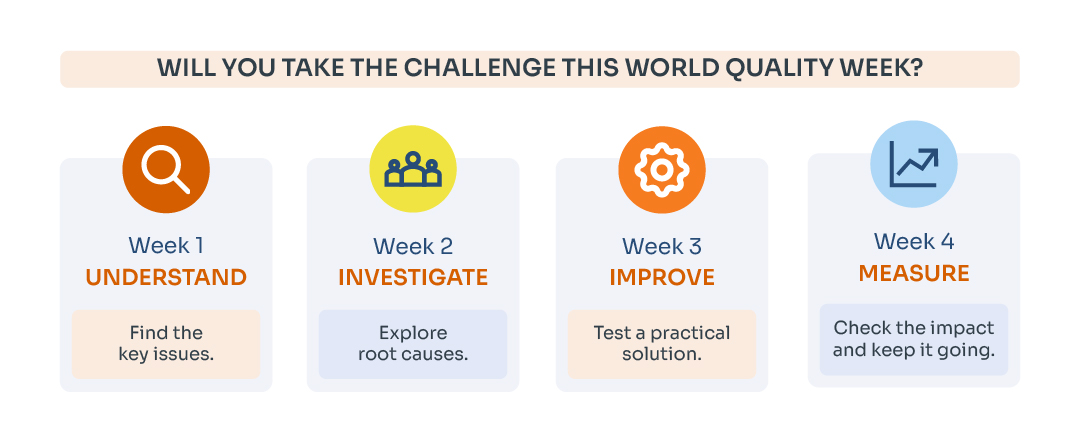
Take the 30-Day GxP QMS Improvement Challenge
Challenge your team or organisation to identify and implement one meaningful improvement to your GxP QMS over 30 days.
The objective isn’t to transform your entire QMS in a month. Instead, it is about identifying a focused opportunity for improvement, understanding the underlying issue, implementing an appropriate change and evaluating whether that change has delivered the intended result.
Week 1 – UNDERSTAND
Start by reviewing your deviations, CAPAs, audit findings and quality metrics. Identify the top three recurring problems or areas of risk and consider what the available data is telling you about how your processes really work.
Rather than looking at individual issues in isolation, consider whether recurring findings could highlight a wider opportunity for improvement. Understanding the current situation provides a clear baseline against which future changes can be evaluated.
Week 2 – INVESTIGATE
Bring Quality and operational colleagues together to explore the root causes.
Ask whether existing actions are addressing the underlying problem or simply treating the symptoms. Different perspectives can reveal opportunities that might otherwise be missed and help build a more complete understanding of how processes operate in practice.
This cross-functional involvement is also important in ensuring that proposed improvements reflect both QMS requirements and the realities experienced by the people working within those processes every day.
Week 3 – IMPROVE
Once you understand the issue and its potential root causes, test a practical solution.
This could mean simplifying a process, improving a form, strengthening training, clarifying responsibilities or introducing a more effective way to monitor performance.
Involve the people who use the process every day in developing the solution. Their practical knowledge can help ensure that improvements are workable, relevant and capable of being sustained, rather than simply introducing another layer of procedure.
Week 4 – MEASURE
Finally, evaluate the results against your baseline.
Has the change reduced errors, improved efficiency or strengthened controls? What does the available quality data tell you about the effectiveness of the improvement?
Capture lessons learned and agree how effectiveness will continue to be monitored over time. Measurement is important not only for demonstrating whether the initial change has worked, but also for supporting an ongoing cycle of evidence-based continuous improvement.
Small improvements can make a meaningful difference
The goal isn’t to overhaul your QMS in 30 days. It’s to demonstrate that small, evidence-based improvements can deliver meaningful and sustainable gains.
By involving colleagues beyond the Quality function, businesses can draw on different experiences and perspectives to:
- Drive consistency through clear procedures, defined responsibilities and effective training.
- Anticipate and manage risk by identifying vulnerabilities, learning from deviations and implementing meaningful CAPAs.
- Enable continuous improvement by turning quality data, audit findings and operational insights into action.
- Build a culture of quality where everyone understands their role, takes ownership and feels empowered to speak up and improve.
Ultimately, a more engaged workforce can help transform the QMS from something people simply follow into something they actively contribute to and improve.
A QMS should be more than a collection of SOPs and records. It should be a living system that supports informed decision-making, proactive risk management and operational excellence.
Quality powers performance when compliance becomes part of how we work, not just what we document.
Will you take the challenge?
What one improvement could make the biggest difference to your QMS?
Take the 30-Day GxP QMS Improvement Challenge this World Quality Week and use the next 30 days to understand, investigate, improve and measure.
If you would like to speak to someone from our Quality team about improving your QMS, contact enquiries@acornregulatory.com.